
Linking ecology and evolution
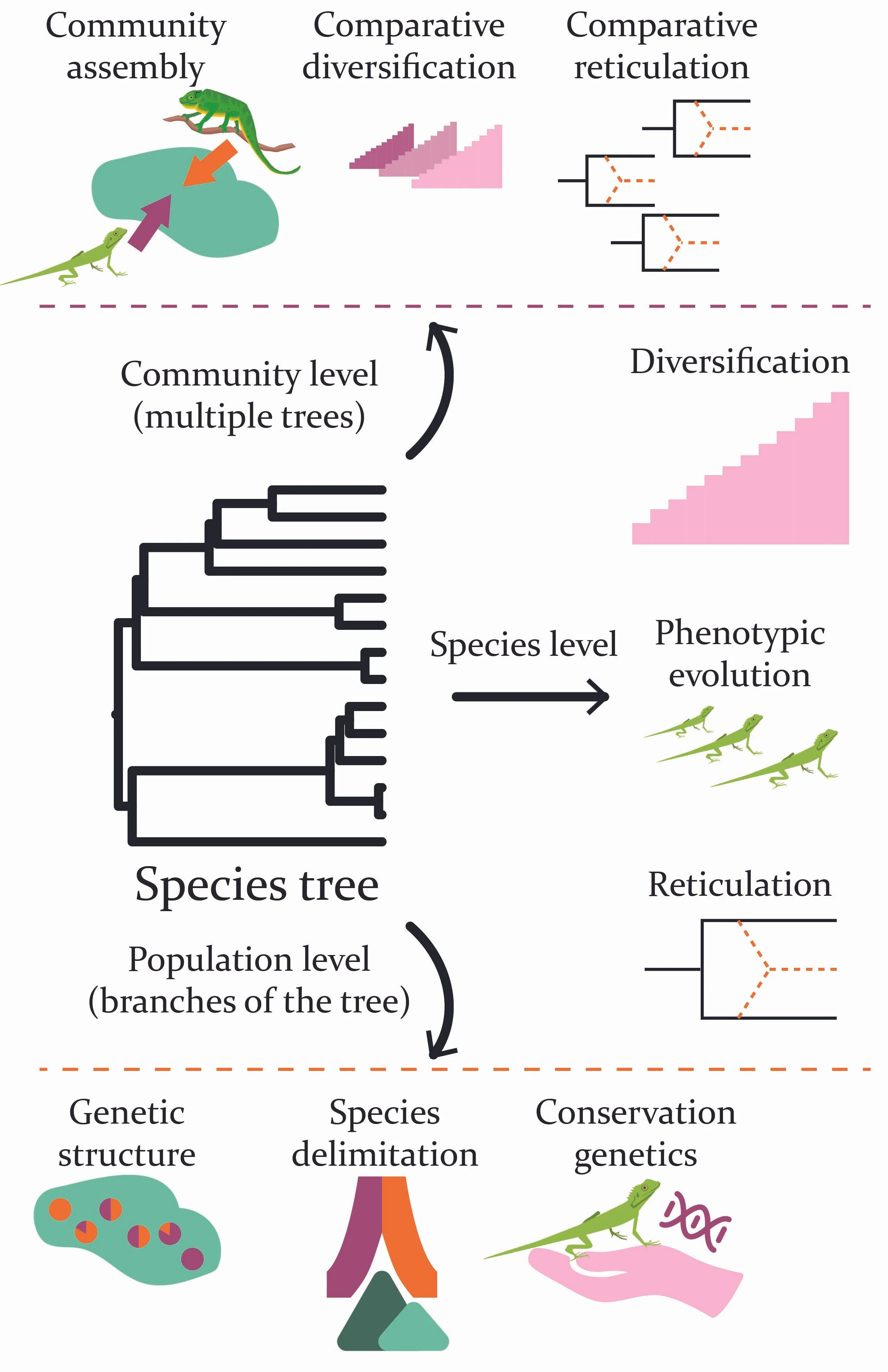
Research in the Laboratory for the Integrative Study of Biodiversity focuses on the processes shaping the diversity of life. Using terrestrial vertebrates (mainly amphibians and reptiles) as model system, we seek answers to three fundamental questions:
1) Why do organisms live where they do?
2) Why do they look the way they do?
3) Why are some groups more diverse than others?
An additional question stems from the answers to these three:
4) Given our understanding of the processes shaping biodiversity, how can we protect species from extinction?
To tackle these questions, we work at the interface of ecology and evolution, examining how ecological processes scale up to shape patterns of species diversity, phenotypic and genotypic variation, and community composition.
Our research incorporates approaches used in community ecology, comparative biology, phylogenetics, genomics, conservation biology, phylogeography, and species delimitation. If any of these interests you and, even better, if you’re interested in their conceptual and methodological integration, you will be right at home in the lab!
Active Projects
Phenotypic and genomic convergence in Abronia lizards
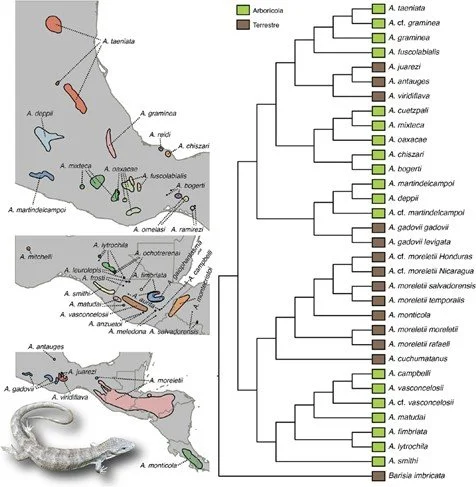
The genus Abronia contains both terrestrial and arboreal species, each showing unique adaptations. This project funded by SECIHTI will use morphometric and whole-genome-sequencing data to test for convergence associated with habitat use in the genus. Using an updated phylogenetic hypothesis, we will test whether the phenotype and genotype show convergent signatures of adaptation to terrestrial and arboreal habits, respectively (photo in the figure by Josiah Townsend, CC BY-SA 4.0).
Diversification, developmental plasticity, and conservation of true salamanders and newts
In collaboration with the University of Kentucky and other international institutions, we’re using a phylogenomic dataset to infer the evolutionary history of the true salamanders and newts (family Salamandridae), a diverse group that is mainly found in the Holarctic realm. Based on this phylogenetic framework, we’re testing the relationship between diversification dynamics, ancient climate change, and interspecific interactions. We’re also looking into the evolution and climatic predictors of facultative paedomorphosis, a type of developmental plasticity. Finally, we’re collaborating with the University of Kentucky, National University of Laos, and North Carolina Museum of Natural Sciences to develop molecular tools for the hands-on conservation of an endangered newt from Laos.

Ecology, evolution, and systematics of monitor lizards
Monitor lizards (Varanidae) are a widespread and charismatic group that includes the largest (non-snake) living lizard, the Komodo dragon. Previous research showed that abiotic and biotic factors acted together to shape spatial patterns of species richness and morphological variation. Morphological diversification was allowed by the lability of postnatal ontogeny, which has been influenced by habitat use and inter-specific competition. Another study found that hybridization between the Komodo dragon and a group of Australian monitors had a long-lasting phenotypic effect. Other work has focused on the environmental factors shaping genetic structure in a couple of species complexes, resulting in updates to their taxonomy. Ongoing projects are focused on the ecological factors shaping claw shape variation in the family, phenotypic and genomic adaptation to climate in ridge-tailed monitors, and the biogeographic history and taxonomy of Australasian monitors.

Evolution and systematics of blue-tailed skinks
Blue-tailed skinks (Plestiodon) are very close to our hearts. The group is notable for its variation in reproductive traits and its disjunct distribution encompassing eastern Asia and North America. Besides, its diversity has been underestimated, particularly in the environmentally complex Mexican highlands. Previous work showed how the integrative analysis of morphological, environmental, and molecular data can resolve taxonomy in the context of cryptic speciation. Collaborative projects have focused on the phylogenomics of the P. brevirostris group and reproductive ecology of P. lynxe. Together with collaborators, we have described two new species: P. longiartus and P. lotus. Ongoing projects are focused on the evolution of body size, the prevalence of inter-specific hybridization, and the systematics of Mexican taxa.
